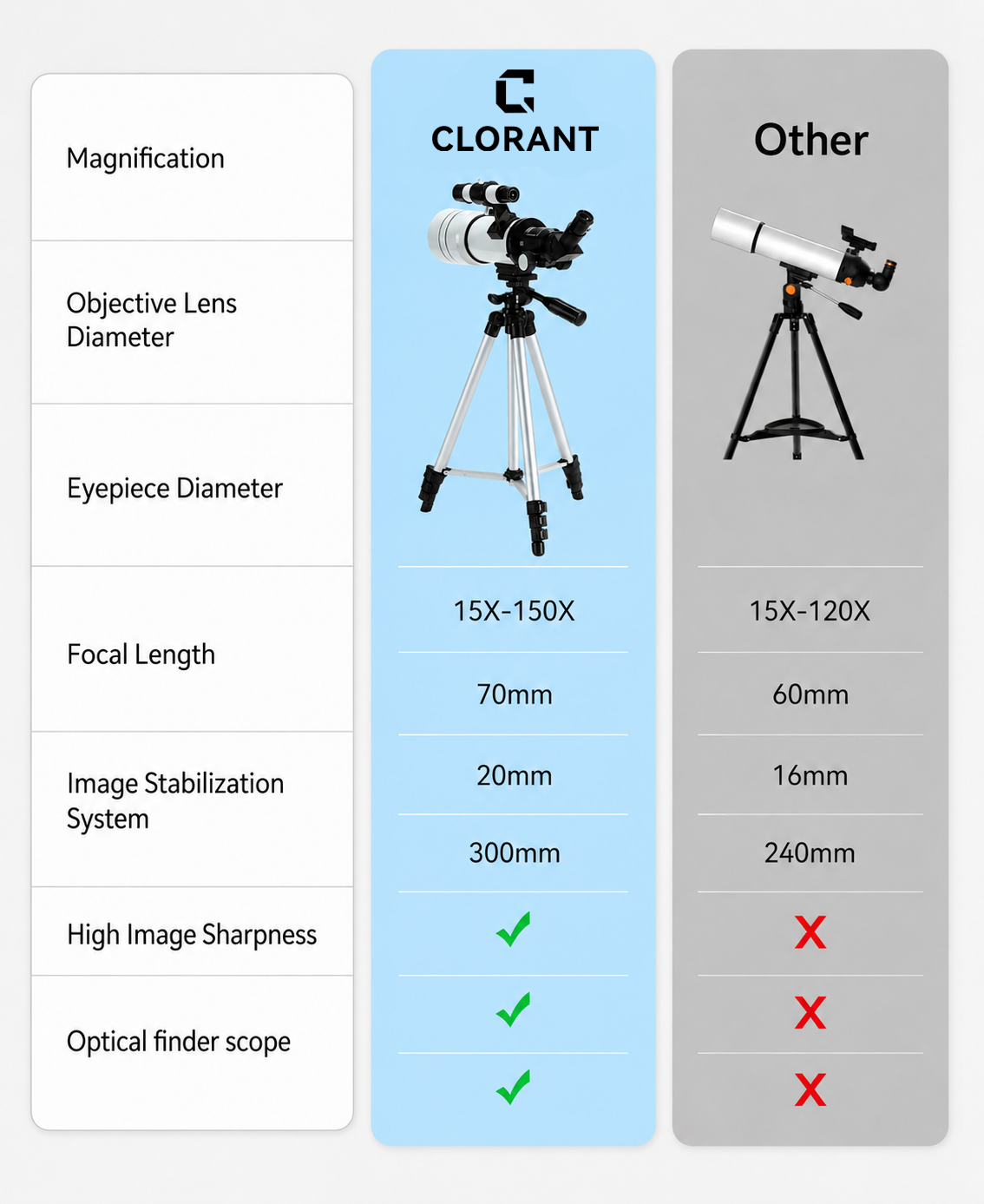
Clorant Astronomical Telescope
Clorant Astronomical Telescope
Couldn't load pickup availability

Product Specifications
Product Specifications
Shipping Information
Shipping Information
Returns & Refund Policy
Returns & Refund Policy
Clorant Astronomical Telescope – 70mm Refractor Telescope with FMC Optics, 300mm Focal Length & Smartphone Holder
Discover the Night Sky with the Clorant Astronomical Telescope
The Clorant Astronomical Telescope gives beginners, families and curious stargazers an accessible way to explore the Moon, bright planets, star fields and distant landscapes from home.
Built around a 70mm objective aperture and 300mm focal length, the Clorant Astronomical Telescope combines a refractor optical system with Fully Multi-Coated optics, multiple eyepiece combinations, an optical finderscope, correct-image prism, large focusing wheel and smartphone holder.
Whether you're seeing lunar craters through a telescope for the first time, introducing your family to astronomy or turning the telescope toward distant scenery during the day, the Clorant Astronomical Telescope is designed to make observation straightforward and rewarding.
Why Choose the Clorant Astronomical Telescope?
A Versatile Optical System for Astronomy and Daytime Exploration
Instead of relying on extreme magnification claims alone, the Clorant Astronomical Telescope combines a useful aperture, coated optics and interchangeable optical accessories to give you flexibility for different targets.
Key Features
- 70mm objective aperture
- 300mm focal length
- Refractor optical system
- Fully Multi-Coated optics
- Multiple magnification combinations
- 6x and 12x eyepieces
- 1.5x and 3x Barlow lenses
- Optical finderscope
- Correct-image zenith prism
- Large focusing wheel
- Smartphone holder
- Mounting bracket
- Suitable for astronomical and terrestrial observation
70mm Large Aperture
Collect More Light for Brighter Views
The Clorant Astronomical Telescope uses a 70mm objective lens to gather light from the object you're observing.
Aperture is one of the most important specifications of any telescope because it influences how much light enters the optical system.
The 70mm aperture makes the telescope suitable for observing bright astronomical targets such as:
- The Moon
- Bright planets
- Bright stars
- Larger star fields
- Selected brighter deep-sky objects under suitable dark conditions
During daylight, the same aperture can also provide bright views of distant landscapes and other terrestrial subjects.
300mm Focal Length
Wide Enough to Explore, Flexible Enough to Get Closer
The Clorant Astronomical Telescope has a 300mm focal length, creating a compact refractor system that can be paired with different supplied eyepieces and Barlow lenses.
Lower magnification is generally more useful for initially locating a target because it provides a wider field of view.
Once the target is centred and focused, different compatible optical combinations can be used when you want a closer view.
This makes the Clorant Astronomical Telescope more versatile than a telescope locked into one fixed viewing power.
Fully Multi-Coated Optics
Improve Light Transmission Through the Optical System
The Clorant Astronomical Telescope uses Fully Multi-Coated (FMC) optical surfaces.
Optical coatings are designed to reduce unwanted reflections as light travels through the telescope, helping preserve more of the available light for the final image.
This can contribute to:
- Better brightness
- Improved contrast
- Reduced reflections
- Clearer viewing
- More enjoyable low-light observation
The original source claims up to 99% effective light transmission, but because no independent optical test data is supplied, it is better to focus on the confirmed FMC construction rather than promise a specific transmission percentage.
Refractor Optical System
Straightforward Optics for Astronomy and Terrestrial Viewing
The Clorant Astronomical Telescope uses a refractor design.
Refracting telescopes use lenses to gather and focus incoming light, creating a practical system for observing bright astronomical targets and distant daytime scenery.
For beginners, a refractor can provide a straightforward introduction to astronomy without an overly complicated optical setup.
Explore the Moon
Turn the Lunar Surface into a Landscape
The Moon is one of the best places to begin with the Clorant Astronomical Telescope.
Instead of appearing simply as a bright circle in the sky, magnified observation can reveal major surface features and dramatic changes in light and shadow.
Under suitable conditions, look for:
- Large craters
- Mountainous regions
- Dark lunar plains
- Bright highlands
- Shadows along crater walls
- The changing lunar terminator
The terminator—the boundary between the illuminated and dark portions of the Moon—can be particularly interesting because low-angle sunlight creates stronger shadows across surface features.
Observe Bright Planets
Start Exploring Our Solar System
The Clorant Astronomical Telescope can also be directed toward some of the brightest planets visible from Earth.
Depending on atmospheric conditions, magnification, location and the planet's position, suitable targets can include:
- Jupiter
- Saturn
- Venus
- Mars
For example, Saturn's rings and Jupiter's brightest moons are popular targets for beginner astronomy equipment when observing conditions are favourable.
The level of visible detail will depend strongly on atmospheric stability, light pollution, focus and the optical combination being used.
Explore Star Fields
See Beyond What Your Eyes Can Show Alone
Point the Clorant Astronomical Telescope toward a darker part of the sky and you can begin exploring star fields that are difficult to appreciate with the naked eye alone.
Lower-power viewing is often preferable for larger astronomical targets because it gives you a wider section of sky.
This makes the telescope useful for learning how to locate and identify objects before moving to stronger magnification.
Optical Finderscope
Find Your Target Before Magnifying It
One of the first challenges new telescope users encounter is finding an object through the main telescope.
The Clorant Astronomical Telescope includes an optical finderscope specifically to make this easier.
The finderscope provides a wider, lower-magnification view than the main telescope.
Locate
Find the Moon, planet, star or terrestrial target through the finderscope.
Centre
Position the object around the finderscope's reticle.
Observe
Move to the main eyepiece and refine the telescope's alignment.
Focus
Use the large focusing wheel until the image becomes as sharp as viewing conditions allow.
Large Focusing Wheel
Make Small Adjustments More Easily
Correct focus becomes increasingly important as magnification rises.
The Clorant Astronomical Telescope features a large focusing wheel designed to make precise adjustment easier.
Turn the control gradually while looking through the eyepiece until the target reaches its sharpest point.
This simple mechanical control can make the telescope easier to learn for first-time users.
Multiple Magnification Options
Choose the Right View for the Target
The Clorant Astronomical Telescope includes multiple optical accessories rather than limiting you to one fixed magnification.
The supplied package lists:
- 6x eyepiece
- 12x eyepiece
- 1.5x Barlow lens
- 3x Barlow lens
These accessories allow different optical combinations depending on whether you want a broader view or a closer look at a smaller target.
Start with Lower Magnification
Find First, Magnify Second
One of the easiest mistakes when using a telescope for the first time is immediately selecting the strongest available magnification.
Higher magnification produces a narrower field of view and also magnifies atmospheric turbulence and movement.
A better approach with the Clorant Astronomical Telescope is to begin at lower power.
Find the object.
Centre it.
Focus carefully.
Then increase magnification if the target and conditions support it.
Important Magnification Information
Why We Don't Promise a Specific 120x or 150x Maximum
The original source contains conflicting magnification information. One section advertises 120x, while another describes operation from 15x to 150x.
At the same time, the supplied package identifies the optical accessories as “6x” and “12x” eyepieces plus 1.5x and 3x Barlow lenses without giving the eyepiece focal lengths needed to independently calculate conventional telescope magnification.
For that reason, this description does not advertise an unverified 120x or 150x maximum for the Clorant Astronomical Telescope.
This avoids promising customers a magnification specification that cannot be reliably confirmed from the supplied information.
Correct-Image Zenith Prism
Enjoy Natural Upright Views During the Day
Astronomical telescope optics can produce views that are inverted or otherwise oriented differently from normal eyesight.
The Clorant Astronomical Telescope includes a correct-image zenith prism, making the telescope more convenient when observing terrestrial subjects.
This is especially useful for:
- Landscapes
- Mountains
- Distant buildings
- Coastal views
- Nature observation
- Suitable wildlife observation
Instead of being restricted to astronomy, you can use the telescope to explore distant scenery during daylight too.
Clorant Astronomical Telescope for Beginners
A Simple Way to Start Exploring Astronomy
The Clorant Astronomical Telescope brings together the essential components a beginner needs to start learning the night sky.
The finderscope helps with target location.
The large focusing wheel simplifies focus adjustment.
Multiple optical accessories provide different viewing options.
The correct-image prism expands the telescope into daytime observation.
And the smartphone holder gives you a way to experiment with capturing what you see.
Clorant Astronomical Telescope for Families
Turn a Clear Evening into Something Worth Exploring
Astronomy can become a shared activity rather than another evening spent looking at a screen.
Set up the Clorant Astronomical Telescope outdoors and take turns exploring the Moon, bright planets and stars.
It's an engaging way to introduce younger users to topics such as:
- The Moon's phases
- Planetary movement
- Constellations
- Earth's rotation
- Light pollution
- Basic optics
Children should always use the telescope with appropriate adult supervision.
Smartphone Holder Included
Try Capturing What You See
The Clorant Astronomical Telescope includes a mobile phone holder for positioning a compatible smartphone with the telescope.
This allows you to experiment with basic smartphone photography through the eyepiece.
Try capturing:
- The Moon
- Bright astronomical objects
- Distant scenery
- Interesting daytime views
Smartphone astrophotography requires some patience. Correct alignment, stable positioning, focus, exposure settings and atmospheric conditions can all affect the final image.
Clorant Astronomical Telescope for Daytime Viewing
Explore Beyond the Night Sky
The Clorant Astronomical Telescope doesn't need to stay packed away until sunset.
Its refractor optics and correct-image prism make it useful for suitable long-distance terrestrial viewing during daylight.
Point it toward distant landscapes, mountains or other scenery and use lower magnification for a broader, easier-to-navigate view.
How to Use the Clorant Astronomical Telescope
Get Started in a Few Simple Steps
Step 1 – Assemble the Telescope
Secure the main optical tube to the appropriate mounting system according to the supplied instructions.
Step 2 – Install the Finderscope
Attach and align the finderscope so it points toward the same target as the main telescope.
Step 3 – Select Your Optical Setup
Begin with a lower-power combination whenever possible.
Step 4 – Locate Your Target
Use the finderscope to place the object near the centre of the reticle.
Step 5 – Look Through the Main Telescope
Move to the primary eyepiece and make small positioning adjustments.
Step 6 – Focus Carefully
Rotate the large focusing wheel slowly until the image appears as sharp as possible.
Step 7 – Increase Magnification if Needed
Once the target is centred and focused, experiment with other compatible optical combinations.
Get Better Results from the Clorant Astronomical Telescope
Viewing Conditions Matter as Much as Magnification
Even an excellent telescope cannot remove clouds, atmospheric turbulence or severe light pollution.
For better results:
- Observe away from bright streetlights when possible
- Allow your eyes time to adapt to darkness
- Begin with lower magnification
- Keep the telescope stable
- Avoid observing through a closed window
- Give the telescope time to adjust to outdoor temperature
- Observe when the sky is clear and stable
A darker observing location can make a significant difference when viewing fainter objects.
Technical Specifications
| Specification | Details |
|---|---|
| Product Name | Clorant Astronomical Telescope |
| Optical System | Refractor |
| Objective Aperture | 70mm |
| Focal Length | 300mm |
| Lens Coating | Fully Multi-Coated (FMC) |
| Magnification | Multiple Optical Combinations |
| Supplied Eyepieces | 6x / 12x as Stated by Supplier |
| Barlow Lenses | 1.5x / 3x |
| Finderscope | Optical Finderscope |
| Image Orientation | Correct-Image Prism Included |
| Focusing | Large Manual Focusing Wheel |
| Smartphone Holder | Included |
| Suitable Use | Astronomy & Terrestrial Observation |
What's Included with the Clorant Astronomical Telescope?
| Package Contents | Quantity |
|---|---|
| Clorant Astronomical Telescope Main Tube | 1 |
| Mounting Bracket | 1 |
| Finder Scope | 1 |
| Zenith Prism | 1 |
| Mobile Phone Stand | 1 |
| Dust Cap | 1 |
| 1.5x Barlow Lens | 1 |
| 3x Barlow Lens | 1 |
| 6x Eyepiece | 1 |
| 12x Eyepiece | 1 |
Important Tripod Information
Confirm the Tripod Before Advertising It as Included
The original product description specifically promotes a “sturdy tripod”, but the supplied What's in the Package list does not include a tripod.
Because of that contradiction, a tripod has not been added to the package contents above.
Before publishing “tripod included” on your product page, confirm with your supplier whether your actual Clorant Astronomical Telescope stock includes one.
Frequently Asked Questions About the Clorant Astronomical Telescope
What Is the Aperture of the Clorant Astronomical Telescope?
The Clorant Astronomical Telescope has a 70mm objective aperture, allowing the front lens to gather light for astronomical and terrestrial observation.
What Is the Focal Length of the Clorant Astronomical Telescope?
The telescope has a stated 300mm focal length.
Can I Use the Clorant Astronomical Telescope to View the Moon?
Yes. The Moon is one of the most suitable targets for the Clorant Astronomical Telescope, particularly for beginners. Under good conditions, magnification can reveal prominent craters, shadows and other large lunar features.
Can I See Planets with the Clorant Astronomical Telescope?
Bright planets can be observed when their position and viewing conditions are suitable. Exactly how much detail is visible depends on the planet, atmosphere, optical configuration and observing location.
Can I Attach My Phone to the Clorant Astronomical Telescope?
A mobile phone holder is explicitly listed among the supplied accessories, allowing you to experiment with positioning a compatible smartphone for basic photography through the telescope.
Can the Clorant Astronomical Telescope Be Used During the Day?
One Telescope for the Sky and the Horizon
Yes. The included correct-image prism makes the Clorant Astronomical Telescope suitable for terrestrial observation as well as astronomy.
This means you can use it to explore distant scenery during the day and turn it toward the night sky after sunset.
Can Beginners Use the Clorant Astronomical Telescope?
Learn Astronomy One Target at a Time
Yes. The Clorant Astronomical Telescope is particularly approachable for someone learning how to use a telescope.
Start with an obvious target such as the Moon.
Use lower magnification.
Centre it with the finderscope.
Adjust the main telescope.
Focus slowly.
Once you're comfortable with that process, move on to planets, brighter stars and other targets.
Essential Solar Viewing Warning
Never Point the Clorant Astronomical Telescope at the Sun
Never look directly at the Sun through the Clorant Astronomical Telescope, the finderscope or any optical attachment unless a properly certified solar filter designed for that specific purpose is securely fitted over the front aperture.
Looking at the Sun through an unfiltered telescope can cause permanent eye injury extremely quickly.
Ordinary sunglasses are not suitable solar filters.
Why the Clorant Astronomical Telescope Is Made for Discovery
Start with the Moon and Keep Exploring
The Clorant Astronomical Telescope combines the features that matter when you're beginning to explore astronomy.
A 70mm aperture gathers light for brighter viewing.
A 300mm focal length provides a compact and versatile optical platform.
FMC optics help reduce unwanted reflections.
The finderscope makes targets easier to locate.
The large focusing wheel provides straightforward focus control.
The correct-image prism makes daytime viewing more natural.
Multiple eyepiece and Barlow options let you experiment with different views.
And the smartphone holder gives you a way to start capturing your observations.
Begin Exploring with the Clorant Astronomical Telescope
Your Next Clear Night Could Look Completely Different
You don't need to be an experienced astronomer to start discovering what's above you.
Set up the Clorant Astronomical Telescope, locate the Moon through the finderscope and bring the image into focus. Explore the shadows surrounding lunar craters. Look for a bright planet. Scan a field of stars. Then use the same telescope during daylight to bring distant landscapes closer.
With a 70mm aperture, 300mm focal length, Fully Multi-Coated refractor optics, multiple optical accessories, finderscope, correct-image prism and smartphone holder, the Clorant Astronomical Telescope gives beginners and families a versatile starting point for exploring both the night sky and the world around them.
Clorant Astronomical Telescope — Look Up. Focus In. Start Exploring.